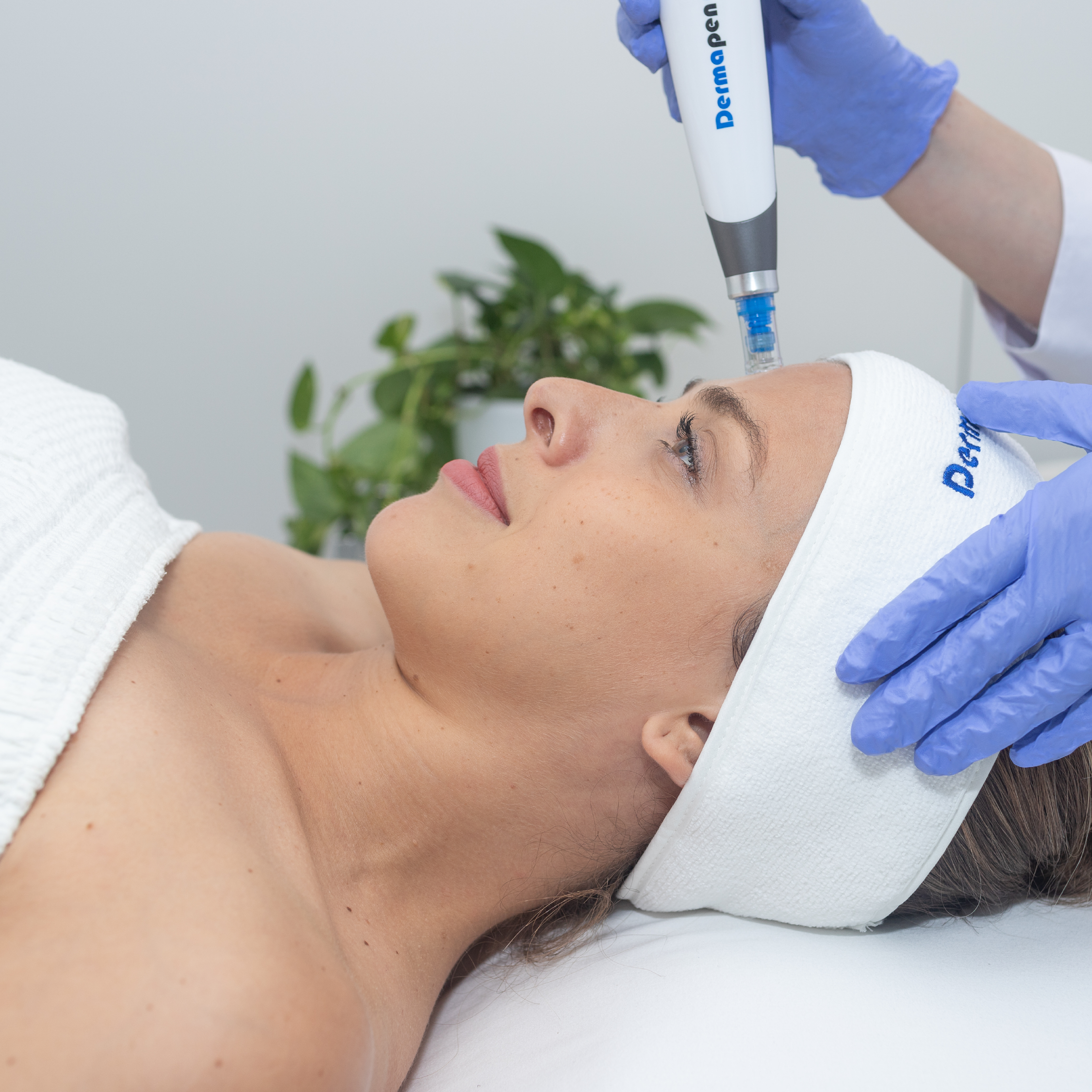
Microneedling
Controlled micro injuries to stimulate a natural repair response that encourages skin renewal and remodelling, and deep product absorption.
Microneedling is a minimally invasive skin-remodelling treatment that uses fine, sterile needles to create controlled microscopic channels within the skin. These micro-injuries initiate the skin's natural wound-healing response — a coordinated process involving inflammation, cellular signalling, proliferation and tissue remodelling. Over time, this can support the production and reorganisation of collagen and other components of the extracellular matrix. I use Dermapen 4, allowing treatment depth, intensity and professional formulations to be selected according to the area being treated, the condition of the skin and the intended outcome.
Not all microneedling is the same. The appropriate treatment for pigmentation may be very different from a treatment for an atrophic acne scar. Skin condition, barrier integrity, inflammation, pigmentation risk, treatment depth, frequency and recovery all need to be considered before treatment.
Acne & Post-Acne Scarring
Acne is a complex inflammatory condition involving the pilosebaceous unit. Sebum production, follicular keratinisation, Cutibacterium acnes, inflammation, hormonal influences and individual susceptibility can all contribute to its development. Microneedling is particularly valuable when addressing atrophic acne scarring and residual textural changes after inflammatory acne has been appropriately managed. By creating controlled micro-injury, microneedling initiates a wound-healing response that can support collagen remodelling within depressed acne scars and progressively improve the appearance of uneven texture. Active, significantly inflamed or infected acne requires a different approach. I assess the condition of the skin before determining whether microneedling is appropriate or whether inflammation and barrier health should be addressed first.
A course of treatment is usually required and is individually prescribed.
Fine Lines & Skin Ageing
The structure and function of skin change gradually throughout life. With age, changes occur within collagen, elastin, glycosaminoglycans and other components of the extracellular matrix. Environmental exposure — particularly ultraviolet radiation — can further influence these processes. Microneedling provides a controlled stimulus that initiates tissue repair and remodelling. Over a series of treatments, this may improve the visible appearance of fine lines, texture and skin quality. Where appropriate, professional treatment formulations may also be incorporated into the protocol according to the condition of the skin.
Treatment courses are generally spaced to allow the skin sufficient time for repair and remodelling between sessions.
Photoageing & Sun-Damaged Skin
Repeated ultraviolet exposure contributes to changes collectively known as photoageing, which can present as uneven pigmentation, coarse texture, fine lines, loss of elasticity and changes in skin structure. Microneedling may form part of a wider programme designed to improve visible texture and signs of photoageing by stimulating controlled remodelling within the skin. Importantly, treatment of photoaged skin is not simply about stimulating collagen. Photoprotection, barrier support, appropriate topical care and management of pigmentation are equally important components of a long-term skin programme.
Scarring
Scar formation is part of the body's natural response to injury. The appearance and structure of scars vary considerably depending on the original injury, location, individual healing response and the type of scar that has formed. Microneedling is particularly useful for selected atrophic scars, where controlled micro-injury can encourage progressive collagen remodelling and improve visible texture. Not every scar should be treated in the same way. Raised, hypertrophic or keloid scars require different consideration, and medical referral may be appropriate before treatment.
Pigmentation
Melanin is produced by specialised cells called melanocytes and transferred to surrounding keratinocytes, where it contributes to skin colour and provides an important protective response to ultraviolet radiation. Hyperpigmentation can arise through several different mechanisms, including ultraviolet exposure, inflammation, hormonal influences and previous skin injury. Microneedling may be incorporated into carefully selected programmes for certain pigmentation concerns, often alongside appropriate topical ingredients and rigorous photoprotection. Because inflammation itself can stimulate pigmentation, particularly in skin susceptible to post-inflammatory hyperpigmentation, treatment intensity is carefully considered. Microneedling can offer an option for a broad range of skin tones; however, suitability is assessed individually rather than assuming one modality is appropriate for every pigmentation disorder.
Rosacea & Reactive Skin
Rosacea is a chronic inflammatory skin condition involving complex interactions between the vascular, immune and nervous systems and the skin barrier. Microneedling is not an automatic treatment for rosacea. For selected individuals with stable, appropriately managed skin, carefully controlled treatment may sometimes form part of a wider programme. During active inflammatory flares, significant barrier impairment or pronounced sensitivity, other supportive modalities may be more appropriate. My priority is always to assess the condition of the skin before deciding whether stimulation or restoration is required.
Professional Infusions
The formulation used during a microneedling treatment is selected according to the skin and the treatment objective. I work with professional Dp Dermaceuticals formulations developed for use within Dermapen treatment protocols. Depending on the treatment, this may include hydration and skin-supportive formulations or selected advanced technologies.
EXO-SKIN™
For selected skin-remodelling programmes, EXO-SKIN™ may be incorporated into the professional treatment protocol. Exosomes are nanoscale extracellular vesicles involved in communication between cells. They can carry proteins, lipids and nucleic acids and are an emerging area of research in tissue repair and regenerative medicine. Exosome-based cosmetic technologies are developing rapidly, and research into their dermatological applications continues to evolve.
Treatment Planning
Microneedling is a progressive treatment rather than a single intervention. The number of treatments and interval between them depends upon what we are treating, treatment depth, skin response and the time required for tissue remodelling. Rather than prescribing the same course to every client, I develop the treatment plan following assessment and adjust it according to how the skin responds.